ACME Macro China Daily Brief
China, First Read
中国战略要闻
Strategic intelligence on China, read between the news
69% China’s share of world rare-earth mining in 2025; the export-control pause ends Nov 10 |
6% Banks’ reserve ratio on forex deposits from Nov 15, up from 4% |
$13bn Raised by Chinese embodied-AI firms in H1, five times a year earlier |
−13% A-share companies’ third-quarter net profit, year on year |
- Beijing bets on stability as Democrats take Congress
- Rare-earth truce nears expiry in silence
- The PBoC moves to slow the renminbi’s rise
- IPO pause reported as profits fall 13 per cent
- DeepSeek reportedly shifts training to Huawei chips
- Robot makers race to build AI brains
- Beijing moves towards a national AI law
- Regulator warns the AI boom is crowding out credit
- Green power targets get legal teeth
- Beijing presses Taipei and Manila before Apec
01 · Geopolitics
Beijing bets on stability as Democrats take Congress and a Shenzhen summit nears

The Great Hall of the People in Beijing. Photo: Dominic Kurniawan Suryaputra / Unsplash
China called Tuesday’s US midterm elections a “domestic” affair and said it “is willing to work with the US” to manage differences and build a “constructive strategic relationship based on respect and equality”, foreign ministry spokesperson Mao Ning said on Wednesday, according to Anadolu Agency and Al Jazeera. Democrats won control of both the House and the Senate, with projections cited by Anadolu giving them 53 Senate seats and at least 218 in the House.
Mao also said China was “in communication with relevant parties” about a meeting of the Chinese, Russian and US heads of state, CGTN reported, the first time Beijing has acknowledged such talks. The question was whether a trilateral summit could take place on the sidelines of the Apec leaders’ meeting in Shenzhen on November 18–19, where Xi Jinping is expected to host Donald Trump. The Wall Street Journal has reported that Vladimir Putin proposed the format to Trump in an October 9 call.
What to watch
Beijing is betting on the White House, which still controls tariffs and export controls, and treating a Democratic Congress as noise. Expect more China bills and hearings from Capitol Hill, but the decisions that matter come in Shenzhen and before the January 10 expiry of the tariff truce. A three-way summit with Putin would put China at the centre of any Ukraine settlement.
Sources: CGTN · Anadolu Agency · Al Jazeera · Meduza / Bloomberg
02 · Geoeconomics
China’s rare-earth truce nears its November 10 expiry with no word from Beijing

A container ship and cranes at a port. Photo: Albert Stoynov / Unsplash
The one-year suspension of the rare-earth export controls China announced in October 2025 runs out on November 10, and as of Tuesday Beijing had published no legal notice extending it, according to an industry update by Radial Magnet. A commerce ministry official said on September 28 that the wider trade arrangement with Washington would run to January 10, 2027, but did not mention rare earths by name, Startup Fortune reported. The suspended rules would add five elements, including erbium, holmium and europium, to China’s licensing regime and reach foreign-made products containing Chinese rare-earth material.
The April 2025 licensing requirements on seven medium and heavy rare earths, including dysprosium and terbium, were never paused. China produced 69.2 per cent of the world’s mined rare earths in 2025 and processes up to 90 per cent, according to GlobalData. Magnet exports to the US fell to 512 tonnes in August, down 13 per cent year on year, the Financial Times reported, citing customs data.
What to watch
Rare earths are Beijing’s strongest card going into Shenzhen, and silence keeps it in play. The most likely outcome is a quiet rollover tied to the Xi–Trump meeting, but the extraterritorial rule is the lever that matters for carmakers, defence and chip groups worldwide. Boards should assume licensing friction persists even if the pause is renewed.
Sources: Radial Magnet (Nov 3 update) · Startup Fortune · Mining Technology / GlobalData
03 · Macro policy
The PBoC tightens dollar liquidity to slow the renminbi’s rise

Shanghai’s Lujiazui financial district. Photo: Freeman Zhou / Unsplash
The People’s Bank of China will raise the share of foreign-currency deposits that banks must hold in reserve from 4 per cent to 6 per cent from November 15, its first increase since late 2021, Caixin reported. Based on nearly $1.2tn of foreign-currency deposits at the end of June, the move could drain about $24bn of dollar liquidity. The renminbi closed onshore at 6.6458 per dollar on November 2, its strongest in more than four years, and has gained more than 9 per cent since the start of last year.
The central bank also set a weaker-than-expected daily reference rate of 6.7150, and the currency eased to about 6.67 on Tuesday. On the same day a State Council report to the National People’s Congress Standing Committee pledged to expand the international use of the renminbi and to accelerate an “independent and controllable” cross-border payment system, China Daily reported, citing Xinhua.
What to watch
Beijing wants a stronger renminbi, but a gradual one that does not crush exporters already squeezed by price wars. Treasurers should plan for managed appreciation rather than a step change. The payments push matters more over five years: it widens a renminbi channel that sits outside dollar-based sanctions.
Sources: Caixin · China Daily / Xinhua (financial work report)
04 · Capital markets
Regulator reportedly halts listings as corporate profits fall 13 per cent

The Shanghai skyline and Huangpu River. Photo: Denys Nevozhai / Unsplash
The China Securities Regulatory Commission has told investment banks to pause initial public offerings and has temporarily suspended large share sales by existing shareholders until markets recover, the Financial Times reported, citing three people familiar with the discussions. Reuters could not verify the report and the regulator did not comment. The CSI 300 index fell 8.5 per cent in October, its worst month in more than a decade.
Earnings explain part of the gloom. Combined net profit of mainland-listed companies fell about 13 per cent year on year in the third quarter, after rising roughly 25 per cent in the second, Caixin reported, based on 5,572 of 5,577 companies. Financials’ profits dropped 31 per cent as the stock-market windfall faded, while technology profit growth slowed to 32 per cent. China Merchants Securities expects a marginal improvement in the fourth quarter on a low base.
What to watch
Closing the primary market is Beijing’s oldest tool for defending share prices, and it lands on a full pipeline of AI and chip listings that fund the country’s technology drive. Companies planning mainland or dual listings should build in delay. Hong Kong is the likely beneficiary if the pause holds into 2027.
Sources: Reuters (FT report) · Caixin (earnings)
05 · Frontier tech: AI compute
DeepSeek reportedly plans to train its next model on Huawei chips

A computer processor. Photo: Brian Kostiuk / Unsplash
DeepSeek plans to use Huawei’s Ascend processors to train its next-generation V5 model, STAR Market Daily reported on Tuesday, citing multiple industry sources, according to TechNode. Neither company has confirmed the plan, and no chip count or timetable was given. Ascend has so far mainly been used to run DeepSeek’s models rather than to train them, so the shift would extend Huawei’s hardware into the most demanding stage of AI development.
The report follows a Financial Times report this week that Nvidia has told data-centre partners most of their cloud capacity must go to non-Chinese customers, narrowing Chinese developers’ access to overseas compute. Zhu Mingxuan of JoyIn Technology told Reuters that US export controls on advanced Nvidia chips will become a serious problem as AI systems grow more powerful, and Reuters noted it is unclear how far Huawei’s alternatives can fill the gap.
What to watch
A frontier model trained end to end on Chinese chips would be the clearest sign yet that export controls are slowing China rather than stopping it. The tests are V5’s benchmark results and whether Huawei can supply Ascend clusters at scale. Success would turn Huawei into the default AI hardware supplier for markets that cannot or will not buy American.
Sources: TechNode / STAR Market Daily · Taipei Times / AFP (FT report) · Reuters
06 · Frontier tech: robotics
China’s robot makers shift the race to AI ‘brains’ as funding quintuples
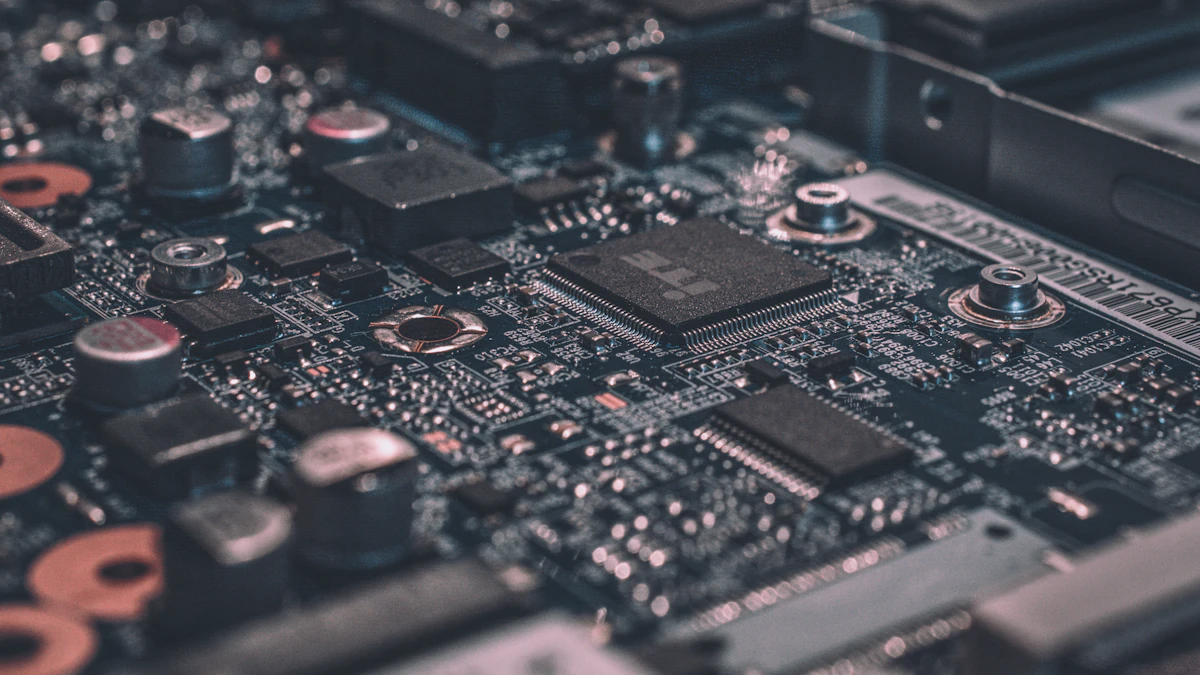
A circuit board. Photo: Alexandre Debiève / Unsplash
Chinese embodied-AI companies raised Rmb93.5bn ($13bn) across 322 deals in the first half of 2026, five times the amount a year earlier, according to ITjuzi data cited by Reuters. Money is moving from hardware makers to developers of the software that lets robots learn tasks without being programmed for each one. X Square, Galaxea and Spirit AI are each valued at about $3bn, and UBTech has advertised a chief scientist role paying up to Rmb124mn.
Chinese developers are betting on factory scale and real-world data. Spirit AI has hired about 1,000 people to record everyday and industrial tasks, and Ant Group’s Robbyant trained a model on 160,000 hours of material across robots from 17 brands, Reuters reported. CATL says Spirit AI robots connect flexible wires in battery-pack testing with more than 99 per cent success. Chinese factories installed about 354,000 industrial robots in 2025, 59 per cent of the global total, according to the International Federation of Robotics.
What to watch
Robot hardware is becoming a commodity, and the value is moving to models and training data, where China’s factory floor is an unmatched laboratory. US labs still lead on how quickly robots learn new skills. Expect the export-control debate to widen from chips to robot AI and industrial datasets, and Chinese automation to reach western supply chains sooner than many manufacturers plan for.
Sources: Reuters · Vision Times (IFR data)
07 · AI governance
Beijing speeds up work on a single national AI law

A data-centre server aisle. Photo: İsmail Enes Ayhan / Unsplash
China will accelerate “comprehensive” legislation on artificial intelligence and widen rules covering its core inputs and key applications, Wang Ruomeng of the National Development and Reform Commission told a news conference on Tuesday, Caixin reported. The law would set up the main pillars of a national AI legal system, with rules on data, computing power and algorithms and safety standards across the technology’s life cycle.
China has no unified AI law. It regulates by technology, with separate rules for recommendation algorithms, deep synthesis and generative AI, and Shenzhen has its own regulations. A draft AI law has sat on legislative plans since 2023. The NPC Standing Committee, sitting until Friday, is also due to ratify the agreement founding the World Artificial Intelligence Co-operation Organisation, which almost 40 countries have signed, according to NPC Observer.
What to watch
A national statute would replace patchwork rules with one compliance regime for every model and data centre in China, including those of foreign firms. Watch for a draft on the 2027 legislative plan. Paired with WAICO, it gives Beijing a template to export to the global south as the EU’s AI Act phases in.
Sources: Caixin · NPC Observer
08 · Financial stability
Banking regulator warns the AI boom is crowding older industries out of credit

Network cabling in a data centre. Photo: Taylor Vick / Unsplash
Xiao Yuanqi, a vice-minister at the National Financial Regulatory Administration, warned on Tuesday that excessive global investment in artificial intelligence is pushing up borrowing costs for traditional industries and squeezing them out of finance, Caixin reported. Heavy capital inflows into technology companies are raising leverage and could fuel over-expansion, he told the Global Financial Leaders’ Investment Summit in Hong Kong.
The summit drew about 280 financial leaders, with vice-premier He Lifeng giving the opening keynote by video, according to the Hong Kong Monetary Authority. The warning came as AI-linked shares sold off across Asia. On Wednesday the Hang Seng index slipped 0.2 per cent to 23,489.88 and the Shanghai Composite 0.1 per cent to 3,603.83, smaller falls than in Japan, South Korea and Taiwan, the Associated Press reported.
What to watch
China’s bank supervisor is now treating AI as a source of financial-stability risk, not only of growth. Expect closer scrutiny of lending to data centres and AI start-ups, and window guidance steering credit back to manufacturing. Investors should read it as a ceiling on how far Beijing will let the AI trade run.
Sources: Caixin · HKMA · Associated Press
09 · Energy & climate
Draft law puts quotas and fines behind China’s green power targets

A solar farm. Photo: American Public Power Association / Unsplash
A draft revision of the Renewable Energy Law, sent to the NPC Standing Committee for a first reading on Monday, would set binding renewable consumption quotas for provinces and fine companies that miss them five to ten times the cost of the green certificates needed to cover the shortfall, China Daily reported. Provincial leaders whose regions fall short could be summoned for “accountability talks”. The 2035 targets include non-fossil fuels above 30 per cent of energy use and 3.6bn kilowatts of wind and solar capacity.
China had 690GW of wind capacity by the end of August, up 16.6 per cent year on year, according to the National Energy Administration. Vice-president Han Zheng will attend the COP31 leaders’ summit in Antalya as Xi Jinping’s special representative and visit Georgia between November 6 and 12, the foreign ministry said on Wednesday, CGTN reported.
What to watch
Turning targets into penalties creates a compulsory market for green certificates and direct green power deals. Manufacturers with plants in China, foreign ones included, should expect consumption obligations and rising certificate costs. At COP31 Beijing will present itself as the steady climate power as Washington steps back.
Sources: China Daily (draft law) · China Daily (targets) · China Daily (wind) · CGTN
10 · Maritime Asia
Beijing presses Taipei with more than 100 ships and warns Manila over ‘red lines’

Taiwan’s coastline. Photo: Robson Hatsukami Morgan / Unsplash
More than 100 Chinese navy and coast guard vessels are deployed across the western Pacific, Joseph Wu, head of Taiwan’s National Security Council, said, as reported by the South China Morning Post. Taiwan’s defence ministry detected 49 Chinese military aircraft in the 24 hours to 6am on November 3, the highest daily figure this year, the Taipei Times reported. Su Tzu-yun of Taiwan’s Institute for National Defense and Security Research called the surge a “quiet exercise”: high-intensity grey-zone pressure without announced drills.
In a call with Philippine foreign secretary Theresa Lazaro on Tuesday, Wang Yi said ties faced “malicious interference” and urged Manila to rein in a “small number of politicians” who attack China, AFP reported, citing the Chinese foreign ministry. The Philippine foreign ministry said both sides had agreed to settle disputes through diplomacy and avoid inflammatory rhetoric, ahead of the Asean summit Manila hosts this month.
What to watch
Unannounced, multi-theatre deployments are becoming the norm, which blurs the warning signs that shipping, insurance and chip-supply planners rely on. Beijing is pairing pressure with diplomacy before Apec and Asean. Expect calibrated restraint this month, then a test of Taipei around the PLA’s year-end exercises, with the carrier Shandong likely to join a long-range drill in mid-December.
Sources: Taipei Times · SCMP · UA.News (SCMP report) · AFP via Manila Times · Daily Tribune
|
The calendar ahead Dates boards should hold | ||||||||||||||||
|
ACME Macro Advisory
Method: stories are selected for strategic, forward-looking relevance and read first through Chinese official and financial media (Xinhua, the foreign ministry, Caixin, CGTN), then checked against international reporting. Chinese state media framing is reported as such. Figures are as published by the cited sources.